Dining & Kitchen · Explainer · 5 min ·
How tall should a table centrepiece be? Raise it and see
Why can't you see the person across the table? Usually it's the centrepiece. Raise a vase, a jar of stems or a candle in the middle of a table and watch the line from your eyes climb over it, hiding the face of the person opposite from the bottom up.
The guide shows where seated eyes really sit above a tabletop, why about 30 cm is the usual rule for a low centrepiece, how width matters as much as height, and when something tall is fine. It also covers how to check at your own table and what to use from home before buying anything.
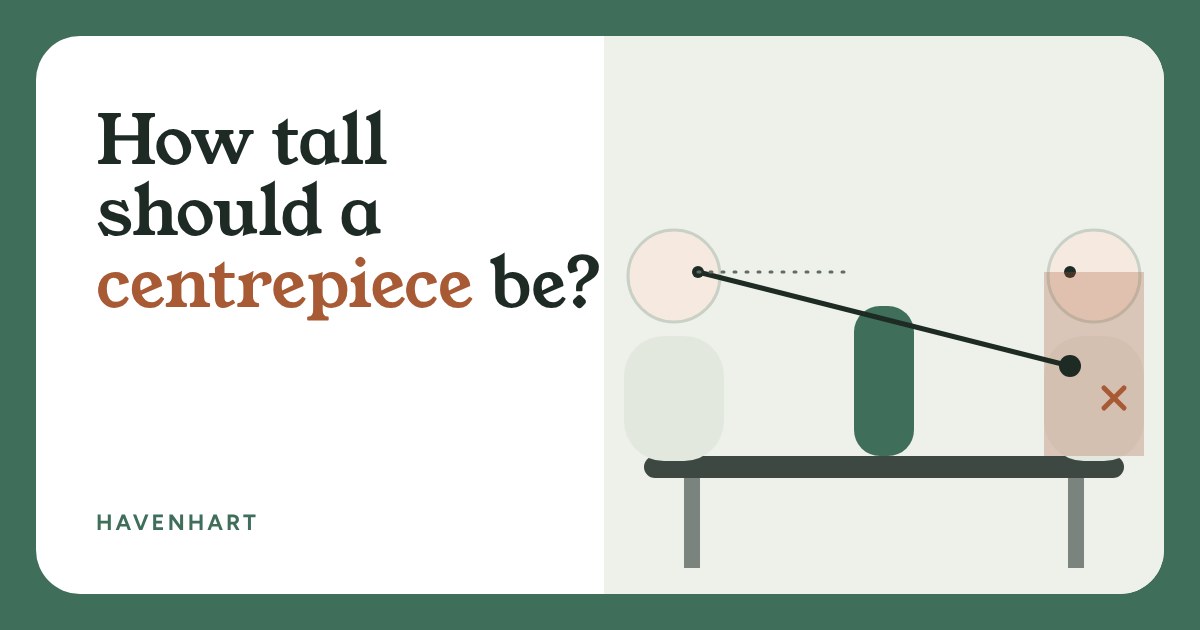
You set the table, lit the candles, and put a big vase of flowers in the middle. Then you sit down and realise you can't see the person opposite. The middle of a table is the one spot everybody looks across, so what stands there decides whether dinner feels like a conversation or a hedge.
Where your eyes really are
When you sit at a dining table, your eyes are a surprising distance above the tabletop. Body-measurement tables for adults put the eye height of a seated person at roughly 70 to 85 cm above the seat. Take a typical chair seat of about 45 cm and a table around 75 cm high, and your eyes end up roughly 40 to 55 cm above the tabletop. Shorter people sit lower, taller people higher, and a cushion or a low chair changes it again.
That is your eye line. Anything standing in the middle of the table that is taller than your eye line cuts the view of the other person's eyes completely. Anything lower than it only hides part of them, from the bottom up. The slider above shows exactly that: the further the line from your eyes has to climb to clear the top of the arrangement, the more of the person opposite disappears below it.
Why about 30 cm is the usual rule
Most styling advice says to keep a centrepiece low, often under about 30 cm (12 inches). The geometry explains why. At eye level you want to see eyes and mouth, because that is where conversation lives. The mouth sits about 9 cm below the eyes and the chin about 14 cm below. If your eye line is 40 cm above the table, a 20 cm wide arrangement 30 cm tall leaves you a view down to roughly the mouth of someone across a 90 cm table; any taller and their mouth starts to disappear.
Notice what also matters: width. The line has to clear the far edge of the arrangement, not just the near one. A wide, flat bowl at the same height hides a little more of the person opposite than a slim jar does. And a shorter person, with a lower eye line, loses far more than a taller one. If your guests range from children to tall adults, design for the shortest eye line at the table.
When tall is fine
A tall arrangement is not forbidden; it only needs to leave the sightline alone. There are three ways to do that.
- Go over the eye line. A slim stem or a few branches whose bulk starts well above eye level (usually 60 cm or more above the table) lets people look under it. It needs a stable base, and it only works if the stems are thin.
- Move it off the middle. A tall vase at one end, on a sideboard or on a shelf behind a bench leaves the centre open.
- Use the table in parts. A low line of small things down the middle (a runner, a couple of little jars) reads as a centrepiece without blocking anyone.
For a round table the distance across is shorter, which makes any centrepiece more of a problem. For a long table, you can place a taller item at the far ends where it blocks nobody's face.
Check it at your own table
You can do this in a minute with no measuring tape drama. Sit in your normal chair, ask someone to hold a ruler or a book upright on the tabletop in the middle, and tell them to raise it until you can only just see their eyes over it. That height, in centimetres, is your own limit. Then measure the height of the vase or arrangement you plan to use and see if it fits under that limit. If you share the table with someone much taller or shorter, repeat it from their chair.
Also measure the table's width and the height of the table itself. If you are choosing a new table, the width decides how much a centrepiece can get away with: a narrow table makes every object feel closer to the eyes.
Things you probably already own
Cosy does not need a shopping trip. A jam jar with a few stems from the garden or the market, a plain bowl of fruit, a small plant in a pot, a couple of tea-light holders, or a stack of books under a bowl to give it a little lift all sit comfortably under the 30 cm line. A tray lets you group small things so they read as one arrangement. Second-hand shops and clearance corners are full of low bowls and little vases if you do want something new to you.
A note about candles
Candles are lovely at table height, but keep flames well away from dried flowers, paper and anything else that burns, put them on a stable, heat-proof base, and never leave them burning unattended. Tall tapers in the middle also block the view of faces just as a vase does, so the same height rule applies. Flameless LED candles are a good option if you have children or pets, or a table that people brush against.
The short version
Keep what stands in the middle of the table under about 30 cm, or lift it clear above the eye line on a slim stem, or move it to one end. Test it from the chair of the shortest person who will sit there. If you can see their eyes and mouth over it, it works.