Bedroom · Explainer · 4 min ·
Why does a bedroom sound echoey? Add a rug and curtains and see
Why does an empty bedroom sound hollow, with claps that flutter and voices that boom? Hard walls, glass and floors bounce sound back again and again, while soft things soak it up.
Set your own room size, add a rug, full curtains, an armchair or one more person, and press clap to watch the echo fade. You get the one-line sum behind it, how much each surface soaks up, free fixes first, and what to measure before you buy.
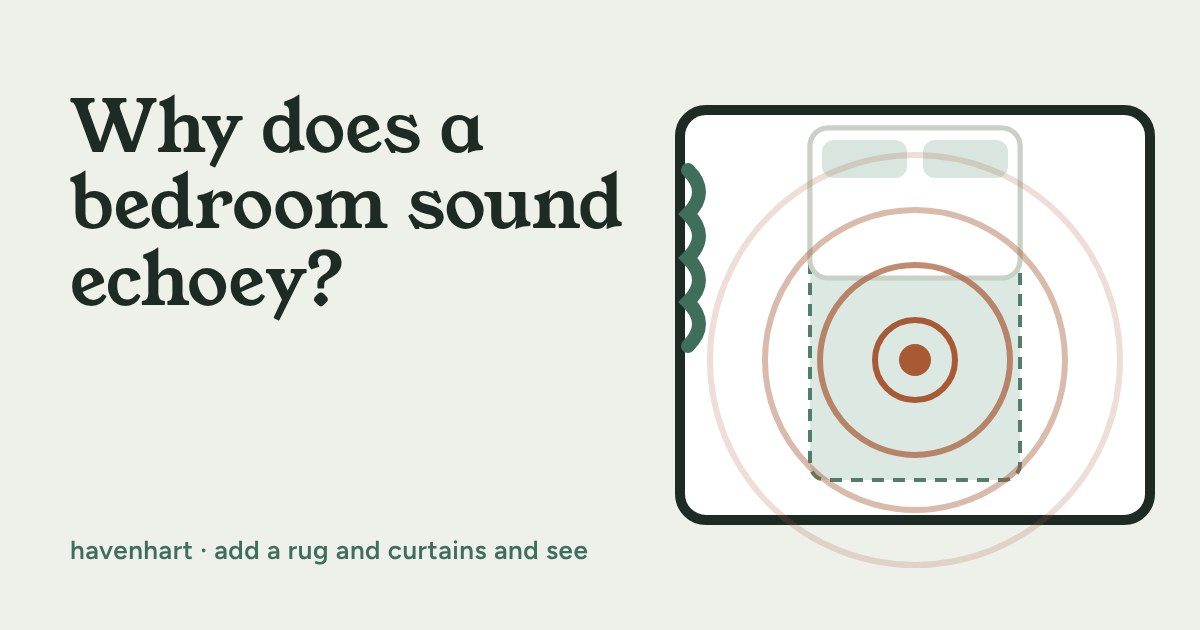
You clap once in an empty room and the sound hangs around: a short, flat flutter that does not happen in a room with a sofa and curtains. Voices sound a little boomy, the TV needs the volume up, and a phone call echoes back at you. In a bedroom it is the opposite of the calm you were after.
Why a bare room rings
Sound spreads out from you, hits a wall and bounces back. Smooth, hard surfaces such as plastered walls, a ceiling, glass and a wooden or tiled floor reflect most of the sound that lands on them. Every bounce keeps the sound alive for a moment longer. Soft, bumpy or porous things, such as a duvet, a thick rug or gathered curtains, soak up part of it each time it touches them.
Acoustic designers measure this with the reverberation time, written RT60: how many seconds it takes a sound to fade by 60 decibels, which is roughly the gap between a clap and silence. A typical bedroom lands somewhere around 0.3 to 0.5 seconds. Rooms for speech, such as classrooms and offices, are usually aimed at about half a second. Hard, empty rooms run well beyond that.
The sum behind it
The old rule of thumb is Sabine's formula: RT60 = 0.161 × volume ÷ absorption. Volume is the room in cubic metres. Absorption is every surface's area multiplied by how much of the sound it soaks up (a number from 0 to 1), all added together. Two things follow. A bigger room rings longer, and every square metre of soft surface you add pulls the time down.
Rounded values at mid-range pitch, from published tables, give you a feel for it:
| Surface | Soaks up about |
|---|---|
| Plastered or plasterboard wall | 5% |
| Wooden floor | 10% |
| Window glass | 18% |
| Carpet or thick rug | 15–55%, depending on thickness and what is under it |
| Heavy curtains, gathered full | about 50% |
| Cloth-covered upholstery | about 50% |
Furnish the room and watch the clap fade
This model is a small bedroom with a double bed, one window and one door. Set the size of your own room, choose a floor, then add a rug, curtains, an armchair or one more person. Press Clap to see the sound fade.
Notice what each piece does. The curtains, because they cover a lot of wall and absorb about half the sound that reaches them, are usually the biggest single change. The rug comes next and helps most on a hard floor. A person or an armchair adds a little each, which is why a lived-in room sounds softer than the same room on moving day.
What to do, cheapest first
Start with what you already own. Close the curtains you have, and if they hang flat, let them hang fuller, because gathered fabric absorbs more than a stretched sheet. Make the bed with a duvet and cushions. Move a bookcase or a wardrobe against a bare wall, since anything with an uneven surface breaks up reflections better than flat plaster. Hang a wool blanket, tapestry or a framed fabric piece on the empty wall opposite the window.
If the room still rings, a rug is the next step. Second-hand rugs and curtains are often thick and well made, and worth checking before buying new. A rug that is thick, with a felt or rubber underlay beneath, absorbs more than a thin flat-weave on its own.
Before you buy anything
Measure first. For a rug, measure the floor you want to cover and the bed, and leave a border of bare floor around the rug. For curtains, measure the window width, add room on each side for the fabric to bunch, and measure from the rail position to the floor. Measure the ceiling height too if you plan a high rail. A tape measure and ten minutes save a return trip.
A calmer-sounding bedroom is rarely about buying more. Rearranging, hanging what you have and borrowing a rug from the sitting room for a week will tell you whether more is needed at all.