Lighting · Tool · 5 min ·
Will your lamp reach the socket? Drag it around and see
A lamp can be in the perfect spot and still be useless if its cord stops a hand short of the socket. The cord has to drop from the table, run along the wall, climb to the socket and leave a little slack, so it needs more than the distance you can see.
Drag a lamp around a room plan to see how much cord it really needs, then find out what to do when it is short. Measure your socket, your spot and your table before you buy a lamp, and read the cord length on its page.
Why does a lamp end up where the cord wants it, not where you do?
You find the perfect spot for a lamp: beside the sofa, next to the bed, in the dark corner by the reading chair. Then you plug it in and the cord stops a hand short, or hangs across the room like a washing line. So the lamp goes wherever the socket allows, and the corner you wanted stays dark.
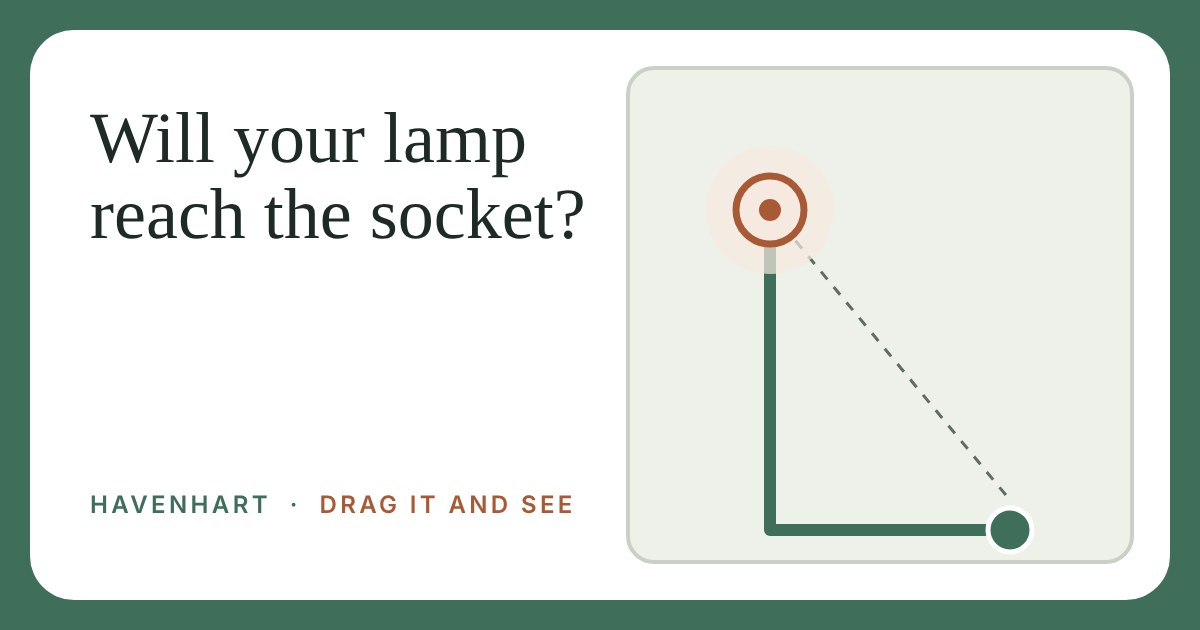
The fix starts with one number: how much cord the lamp really needs. It is more than the distance on the floor, because the cord also has to climb down from the lamp and up to the socket, and it should follow the wall rather than cut across where you walk. Try it below. This is a top-down plan of a room. Drag the lamp (or tap it and use the arrow keys), move the socket, and watch the cord.
How much cord does a lamp need?
Add up four parts, all in centimetres:
- The run along the floor. Measure from the lamp to the wall, then along the wall to the socket. This is longer than the straight line, and that is the point: a cord that follows the wall is out of the way.
- The drop. A table lamp's cord leaves the base on the tabletop and has to come down to the floor first. That is the height of the table, often around 45–75 cm. A floor lamp has no drop.
- The climb. Sockets sit at different heights in different homes, often somewhere around 20–40 cm above the floor, and sometimes higher (above a worktop, say). Measure yours.
- Slack. Leave about 20 cm so the plug is not tugged out of the socket and the cord can bend gently instead of kinking.
Many table lamps come with a cord of roughly 1.5 to 2 metres, but it varies a lot, so read the product page for "cable length" or "lead length" instead of guessing. If a listing doesn't say, ask the shop before you buy.
What to do when the cord is too short
Move things in this order, cheapest first:
- Move the lamp a little. Even 30 cm closer to the socket wall can bring the green route back, and often the lamp still does its job. The plan above shows how far you need to shift.
- Use a different socket. A socket on the next wall may be closer. Check behind the sofa and furniture, as a socket is easy to forget once something stands in front of it.
- Swap the lamp for a longer cord. When you shop, choose a lamp whose cord is long enough on the page, or look for one with a cord of 3 metres. Some lamps are sold with a cord set, and a longer one is a job for someone who knows how to fit it. Don't change plugs or cords on your own.
- Add one extension lead. A single, good-quality lead from the wall socket, laid flat along the skirting, is fine for a lamp. Don't plug one lead into another, and unwind a reel completely before you use it.
- Choose a rechargeable lamp. No cord means no problem. These are good for a corner with no socket nearby and for a balcony or a table you move around.
Keep it safe and tidy
Keep the cord along the wall and out of the walkway, where it is a trip risk and gets stepped on. Never run it under a rug or squeeze it in a closing door, never pull it tight across a corner, and don't coil the extra length behind the lamp. If a plug or cord feels warm or looks cracked, stop using the lamp. Replacing a plug, a cord or a socket is a job for a qualified person, so this guide gives no steps for it.
A few ways to hide a cord without getting fiddly: stick-on clips along the skirting (check they come off a rented wall cleanly), a flat cord cover, or putting the lamp behind or beside furniture so the cord goes straight behind it. A lamp next to a sofa arm, with its cord running down the side and along the wall, almost disappears.
When to break the rule
If a long cord is part of the look, such as a cloth-covered cord hanging in a loose curve beside a bed, keep it off the floor where you walk and let it hang along the wall. And for a lamp you move often, a short cord and a rechargeable lamp may be more useful than the perfect spot. Cosy doesn't mean buying new lamps: with the plan above you might find the lamp you already own simply needs to move 40 cm.
Measure before you go shopping
- The socket: its height above the floor, and its distance along the wall from the corner.
- The spot: its distance from that wall, and from the corner.
- The table: its height, if the lamp stands on one.
- The route: anything the cord has to pass: a doorway, a radiator, a skirting board, a cabinet.
Write those four numbers down, add them as above, and compare the result with the cord length on the lamp's page. A lamp that looks right in the shop is only the right lamp if its cord also reaches your socket.