Colour & Walls · Tool · 5 min ·
How many rolls of wallpaper do you need? Set the repeat and see
Wallpaper is sold in rolls but hung in strips, so a wall that looks like two rolls can quietly need four. Each strip is cut a little longer than the wall, and longer again if the pattern has to line up.
Set your wall width and height, the roll size and the pattern repeat, and watch the strips and the leftovers change. Then take a tape measure to the wall before you order anything.
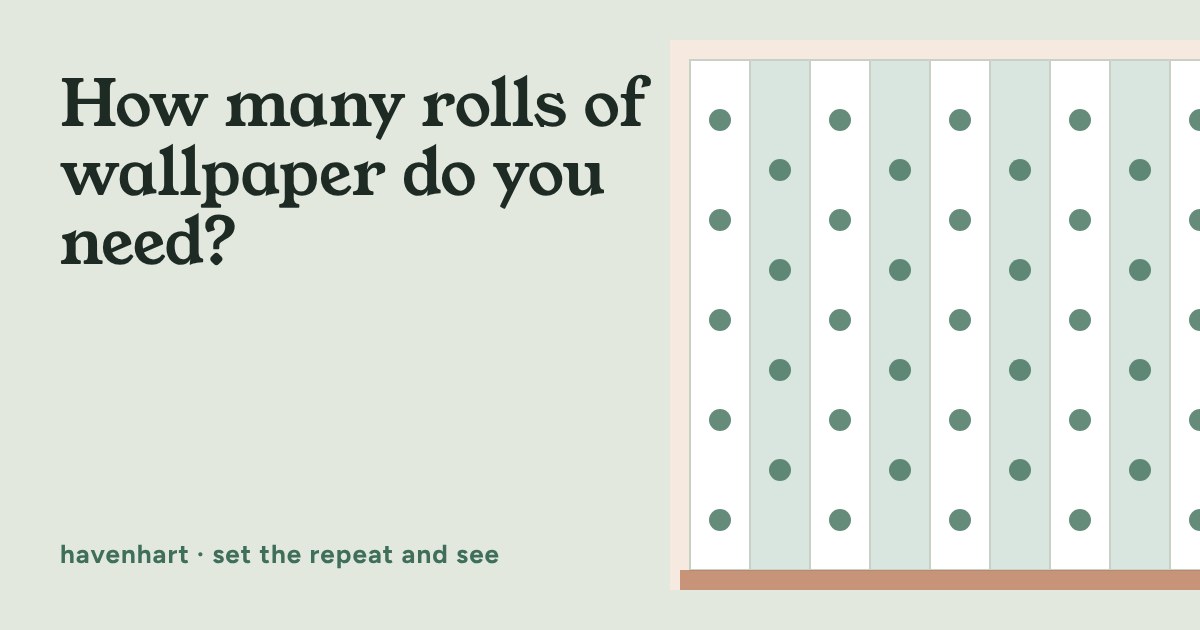
Wallpaper is sold in rolls, but it goes on the wall in strips. That one fact is why a wall that looks like it needs "about two rolls" can quietly need four. Each strip has to be cut a little longer than the wall is tall, and if the pattern has to line up, a little longer again. Whatever is left at the end of a roll is often too short to make another strip.
Think in strips, not square metres
You can work out the number of rolls in four short steps. The planner below does the sums, and you can move every number to see what changes.
- Strips across. Divide the width of wall you want to cover by the width of the roll, and round up. A standard European roll is 53 cm wide and 10.05 m long, so a 4 m wall needs 8 strips.
- Length of one strip. Take the wall height, add a little to trim at the top and the bottom, then round up to a whole number of pattern repeats. The repeat is the distance before the design starts again, and it is printed on the label.
- Strips from one roll. Divide the roll length by the strip length and round down. A strip can't be joined halfway down, so the leftover is waste.
- Rolls. Divide the number of strips by the strips per roll, and round up.
Step 3 is where the surprise lives. On a 2.5 m wall, a plain paper gives three strips per roll, so a 4 m wall (8 strips) needs 3 rolls. Take a half-drop paper with a 64 cm repeat and each strip must be cut about 3.5 m long. Now a roll gives only two strips, and the same wall needs 4 rolls. Try it in the planner below.
Why the pattern repeat changes everything
The repeat is the vertical distance before the design starts again. When the pattern has to line up from strip to strip, each strip must start at the same point in the design, so its length is rounded up to a whole number of repeats. A 2.6 m wall with a 64 cm repeat, plus a little to trim, needs a strip of 3.2 m, because the height is a little over four repeats and you can only cut at a repeat. That is around 60 cm of paper that never reaches the wall.
Papers match in three main ways:
- Straight match. The design lines up at the same height on every strip. Stripes, geometrics and many florals work like this.
- Half drop (offset). Each strip sits half a repeat lower than its neighbour, so the pattern runs diagonally. It looks more natural, but alternate strips start from different points, so it can use more paper. The planner is cautious here and adds half a repeat to every strip.
- Free match. The strips can sit at any height, as with plain, textured and many linen-look papers. These waste the least.
A stripe with no repeat is the easiest of all, which is why many people choose it for a first room.
Walls, windows and doors
Add up the width of every wall you are covering to get one number for the planner. Door and window openings let you skip some strips, but not as many as you would hope: you still need the short pieces above and below a window and above a door, and each of those has to match the pattern. The simple, safe habit is to ignore small openings and treat a big window wall as slightly over-ordered.
For several rooms, work out each room separately and add the rolls up. Combining them can hide the fact that each room has its own leftovers.
Measure before you buy
- Height at three points along the wall, using the tallest. Old walls and ceilings are rarely level.
- Width of each wall, along the skirting, ignoring the fixtures you won't paper behind.
- Roll width, roll length and repeat from the label, not from memory. Sizes vary between makers and countries, and some papers are wider than 53 cm.
- Batch number on each roll. Rolls from different batches can differ slightly in colour, so buy everything at once and check they match before you hang the first strip.
When to break the rule
If a feature wall is only one or two strips wide, don't trust the "one spare roll" advice blindly. A single spare roll might be more than you need, or you might be able to buy a leftover roll from a friend or a second-hand listing. For a rental, check what your lease says about papering walls first, and look at removable options before committing. Cosy doesn't need a whole room: one wall behind a bed or sofa is often enough.
And if you are hanging the paper yourself, order a spare. Cutting the first strip too short is very common, and a second go on the same batch is much cheaper than a mismatched roll later.