Colour & Walls · Explainer · 4 min ·
Which wall should be the accent wall? Walk in and see
An accent wall only works if it is the wall you actually look at. Pick the empty one and the colour becomes a bold patch you pass by without noticing.
In this guide you set where the door and window are and which way your main seat faces, then tap each wall to see how it scores: seen on entry, seen from your seat and unbroken surface. You also get a simple rule for the window wall, when to skip an accent wall altogether, and what to measure and sample before you open a tin of paint.
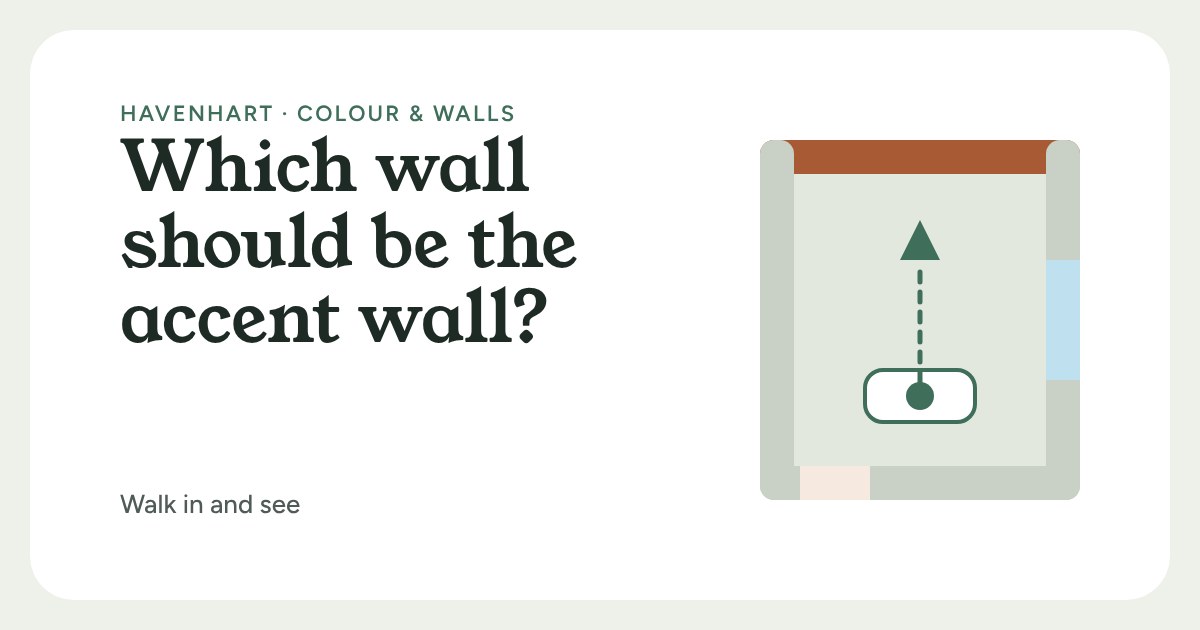
An accent wall is one wall painted a stronger colour than the rest. It is a lovely idea that goes wrong in one very common way: the wrong wall gets picked, usually the one that happens to be empty. The result is a bold patch you only see when you walk past it.
The good news is that choosing is mostly a question of where your eyes actually go. This is a rule of thumb, not a law, but it gets you most of the way there.
Three questions that pick the wall
A wall earns a stronger colour when the answer is yes to as many of these as possible:
- Do you see it first? The wall facing the door is the one that greets you as you step in. The wall behind you when you enter is the last one you notice.
- Do you look at it while sitting? Think of the spot where you spend the evening: the sofa, the bed, the dining chair. The wall in front of that seat is the one you look at for hours.
- Is it a calm, unbroken surface? Colour needs space. A wall that is half window or cut by a door turns into a patchwork, and the colour gets chopped into leftover strips.
Try it below. Set where the door and window are and which way your main seat faces, then tap a wall to see how it scores.
What the scores are telling you
Each wall gets up to three points: one for being seen on entry, one for being seen from your seat, and one for being unbroken. They are rough, on purpose. The aim is to make the trade-offs visible, not to produce a verdict.
Notice how often the best wall is the one opposite the door that also faces the sofa. That is the classic choice for a reason: it is on show from the first second and the last evening. If the best two walls are different, pick the one you look at while sitting. You spend far more time there than in the doorway.
The window wall is a special case
The wall with the window in it is seen against the brightest thing in the room. A deep colour around a bright window can feel high-contrast and a little harsh, especially in the daytime. The wall opposite the window usually gets the most daylight and shows a colour most truly. Colours also change through the day, so test a sample first. Our guide to why paint looks different at 8am and 8pm shows how much.
When to skip the accent wall
Sometimes the honest answer is none of them. If every wall has a door, a window or a radiator on it, a colour will not have a calm surface to sit on. In that case a painted panel behind the bed, a large piece of art, or a rug in the colour you love can do the same job.
If you rent, ask before you paint, and consider the gentler options: a big canvas, a removable wallpaper panel, or a painted board you lean against the wall. All of them can come with you when you move.
Before you commit: measure and sample
- Stand in the doorway and in your usual seat, and look at which wall your eyes land on. Trust that over any plan.
- Measure the clear wall width between door, window and corner. If it is narrow, the colour will look like a stripe.
- Paint a large sample, at least an A3 sheet, and tape it to the wall. Look at it in the morning and in the evening, with the lamps on.
Cosy does not need more paint. One well-chosen wall, or no accent wall at all, is often enough.