Dining & Kitchen · Explainer · 4 min ·
Why does your table wobble? Shim the gap and see
A table that rocks usually has a gap of just a millimetre or two under one leg. Three legs always make a flat plane, so the fourth hovers whenever the floor or the leg lengths are slightly off.
Slide the floor height under each leg in a top-down table, see which leg lifts off, then add a thin shim until it sits flat. You'll also learn why shimming the wrong leg never helps, and how to measure the gap with playing cards before you buy anything.
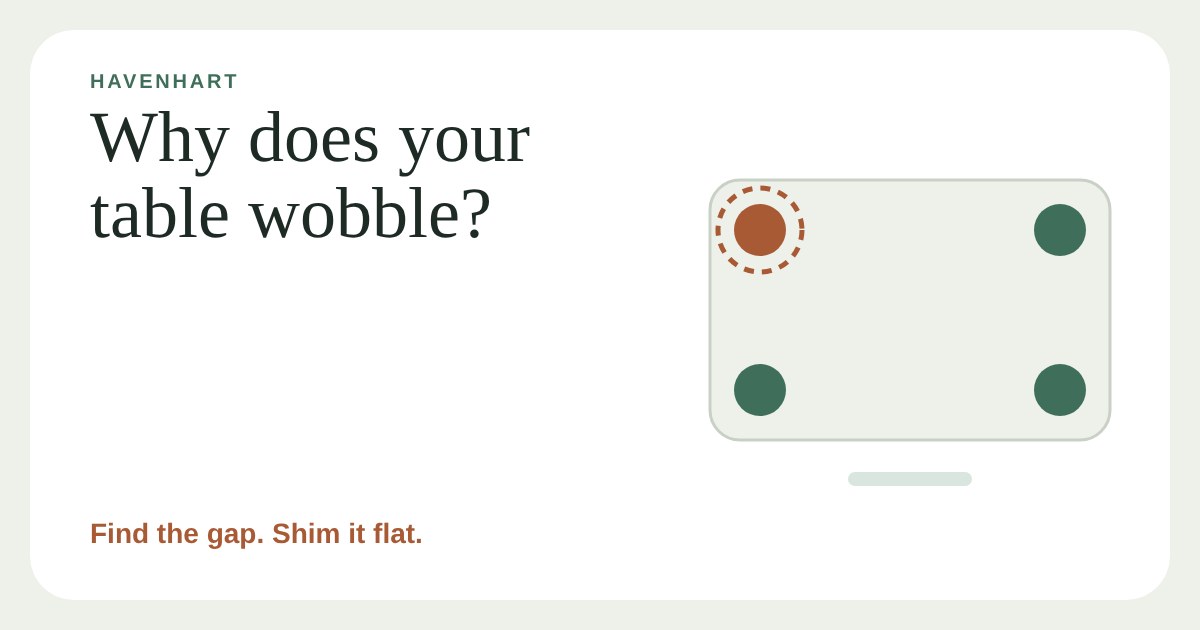
Four legs sound simple, but a table that rocks is one of the most common small annoyances in a home. Cups slide, a candle flame shivers, and you end up folding a beer mat under a foot. The good news: the cause is almost always a gap of a millimetre or two, and it is easy to fix once you know which leg to fix.
Why a four-legged table rocks
Three points always make a flat surface, which is why a three-legged stool never wobbles. A fourth leg has to land in exactly the same plane as the other three, and floors, leg lengths and glued joints are never quite that exact. So the table settles onto three legs and the fourth hovers in the air. Press one corner and it swaps: now a different leg hovers. That swapping is the rock.
Here is the useful part. The legs come in two diagonal pairs. Add up how far each pair reaches (the leg length, minus any bump in the floor under it). If the two sums are the same, the table is flat. If they differ, the gap under the hovering leg equals exactly that difference. So one leg gets one fix, whatever the total mess underneath.
Try it: find the gap, then shim it away
This is a top-down view of a table. Each slider is the floor under that leg: a positive number is a bump that lifts the leg, a negative number is a dip. Watch which leg turns terracotta, then add a thin shim under it until the table sits flat.
The rule of thumb
Look for the leg that hovers, and raise only that leg. Do not shim the legs that already touch: that just lifts the whole table and moves the problem. If you cannot see a gap, slide a thin card under each leg in turn. The leg where it slips in easily is your hovering one.
The rule breaks when the table itself is twisted or one joint is loose. Then the gap moves as you load the table, and no shim fully cures it. Tighten the bolts under the top first, since a table that has loosened over the years often rocks more than it did new.
Ways to fix it, cheapest first
- Turn the table. Rotate it a quarter turn, or move it a hand's width. A different bit of floor can be enough, and it costs nothing.
- Tighten the frame. Check the bolts or screws where the legs meet the top. A loose joint can fake an uneven leg.
- Adjust the feet. Many tables have a screw-in foot or glide. Turn the one under the hovering leg until it touches.
- Add a shim. Stick-on felt pads, a thin rubber pad or folded card work for gaps of a millimetre or two. For a larger gap, a thicker pad is more stable than a stack of thin ones.
- Level the floor side. On a rented floor, a flat rug underlay or a small mat under one leg is easier to undo than anything attached to the table.
None of this means buying a new table. A wobble is a fit problem between floor and legs, and a quick fix usually beats replacing a table you like. If the table will carry candles or hot dishes, test it by pressing each corner before you set them down, since a rocking top can slop a hot pan or tip a candle.
Measure before you add anything
Before you buy pads or feet, find the gap. Slip a stack of ordinary playing cards, or a folded strip of paper, under the hovering leg and count how many fit. A single card is a fraction of a millimetre, so add cards until the table is firm. Then pick a pad of about that thickness. Check the clearance too: a thicker pad can raise the table enough that chairs no longer slide under it, and a table that is a hair taller is rarely noticeable, but a dining chair that can no longer tuck in is.