Dining & Kitchen · Tool · 5 min ·
How deep should a breakfast-bar overhang be? Tuck your knees in and see
A breakfast bar can look right and still be awkward to sit at. The usual reason is the overhang: how far the worktop sticks out past the cupboards beneath it.
Drag the front edge of the worktop and watch where your knees land. Enter your own counter height, stool height and knee reach, and the picture shows whether you sit comfortably close or are pushed back by the cupboard doors. It also checks that your thighs fit under the top, and says when a deeper overhang needs support.
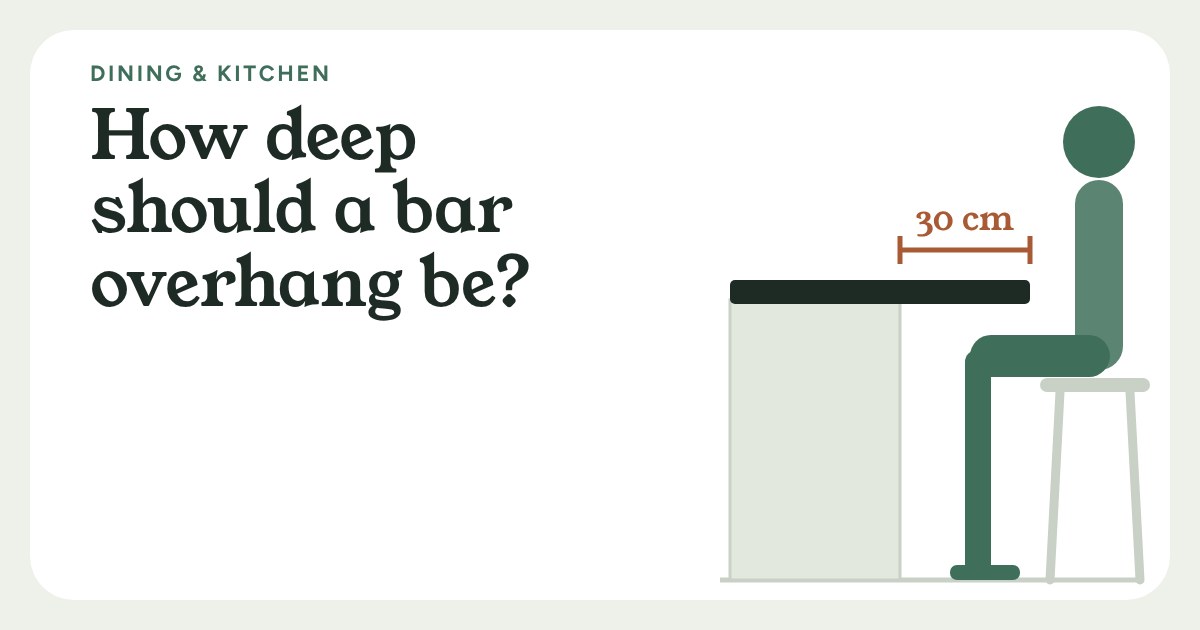
A breakfast bar can look perfect and still be awkward to eat at. The usual culprit is the overhang: how far the worktop sticks out past the cupboards beneath it. Too shallow and your knees hit the cupboard doors, so you sit back and have to lean across the counter for every bite. Too deep and the top can sag or need support.
What the overhang is for
Your knees need somewhere to go. When you sit upright, your knees sit roughly a hand's length to a forearm's length in front of your stomach. If the worktop stops short of that, the cupboard fronts stop your knees, and the whole of you ends up further from the counter than you would like.
Published kitchen-design advice for a seating overhang lands in a similar place: around 25–30 cm is the common comfortable range, 30–35 cm is often given for a busy island, and some designers go to about 38 cm for taller people or a roomier feel. Under about 25 cm, guides say you can perch but not really sit down to a meal. Treat these as starting points, not laws. Your own body and your own stool matter more.
How to read the picture
The cupboards sit on the left and you sit on the right. If your knees have room, you sit close, with a small gap between your stomach and the counter edge. If the overhang is too shallow, the picture slides you back until your knees touch the cupboard and shows how big the gap to the counter has become. The model is deliberately simple. It ignores footrests, the recess under the cupboards for your feet, and how much you lean forward, but it shows the idea well.
The second thing it checks is height. Your thighs need to fit between the stool seat and the underside of the worktop. If the seat is too high for the counter, your thighs are squashed against the underside, and that is a different problem from the overhang. A slightly lower seat or a thinner worktop edge helps. If stool height is your real question, that is a separate check from the overhang.
Measure it yourself
- Stomach to knees. Sit upright on a firm stool or chair, then measure the horizontal distance from your stomach to the front of your knees. Ask someone to hold the tape level.
- Thigh thickness. Measure from the top of your thigh to the seat, sitting down.
- Counter height and seat height. Measure from the floor to the top of the worktop, and from the floor to the top of the stool seat.
- Worktop thickness. A thick slab takes some of the space under it, so measure it at the edge.
- Everyone who will sit. Children, tall guests and anyone with mobility needs may want something different. Measure the one with the biggest need.
Before you buy stools, also measure the width of each stool and leave a hand's width between them, so elbows do not clash.
When the overhang is too deep
A deeper overhang is more comfortable until it is not supported well enough. The guides we read agree that going beyond roughly 30 cm usually calls for a check on the material and its thickness. Heavy stone can often reach further than thin or brittle tops, and some need brackets, corbels, legs or a hidden steel support. This is a job for your worktop supplier or a fitter, not a guess. Never lean on a bar to test it. Ask before you rely on it.
If you rent, or cannot change the worktop
You do not have to rebuild anything to improve a shallow bar. A few easy things can help:
- Choose a stool that is narrower, so it tucks in closer, or one without a tall back.
- Pick a lower seat if your thighs are squashed, or a slimmer seat if your knees are not.
- Sit sideways to a shallow counter and use it as a place for coffee and a laptop rather than meals.
- Try a small table or a second-hand drop-leaf next to the bar for proper sit-down meals.
Rules of thumb are only that. If a bar feels comfortable at 22 cm for you, that is a good bar for you.
What to look for
Before you plan or buy anything, check four things: how far your knees reach, how thick your thighs are, how high the counter is, and how much support the overhang has. Measure first, then compare it with the numbers in the picture. Most of the time, a shift of a few centimetres is the whole difference between a bar you use and a bar you pile the post on.