Bedroom · Tool · 5 min ·
Will your bed fit under the slope? Slide it and see
An attic bedroom looks cosy until you sit up in bed and meet the roof. A sloping ceiling does not ban a bed, it decides which end goes where.
Slide a bed under a sloping ceiling and watch the gap above the head of someone sitting up to read. Put in your own low wall height, how fast the ceiling rises, your mattress height and your sitting height, and see where it fits, and by how much.
You also get how to measure the room, why the head end matters most, and what to try when it is tight: flip the bed, lower the mattress, give the low zone another job. No shopping needed.
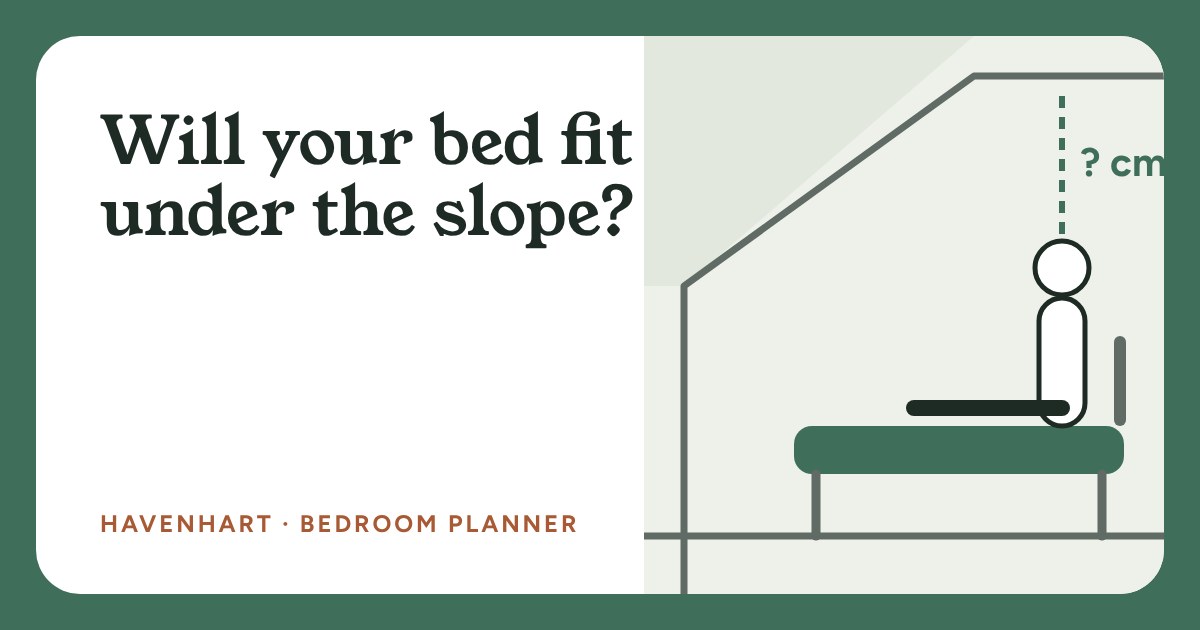
An attic bedroom looks cosy on a listing photo and then you try to sit up in bed and meet the roof with your forehead. A sloping ceiling doesn't ban a bed, it just decides which end of the bed goes where. The trick is to find the spot where the ceiling is still high enough above your head when you sit up to read, and to let the low part of the room do something else.
Slide the bed under the slope
Below is a side view of a room with a sloping ceiling. Drag the bed (or use the slider) and watch the gap above the head of the person reading in bed. Then put in your own numbers.
Why the head end decides everything
Lying down, you only need a hand's width of air above your face. Sitting up, you need the whole height of your upper body: from the mattress to the top of your head is roughly a metre for many adults, and it's more with a thick pillow behind you. So the headboard end is the demanding one. The foot end can tuck into the low part of the room, because your feet don't mind a slope.
Two things change the answer the most. First is how steep the ceiling is: a steeper roof gains height quickly, so the bed only has to move a little way from the wall. A shallow roof gains height slowly and may never give you enough room. Second is how high your mattress sits. Every centimetre you take off the mattress height is a centimetre of extra headroom, which is why a low platform bed or a mattress on the floor often rescues a tricky room.
How to measure your own room
- Low wall height. Measure from the floor up the vertical wall to where the slope starts, in cm.
- Ceiling rise per metre. Measure the ceiling height 100 cm out from the low wall, and subtract the low wall height. That difference is the rise per metre. For example, a low wall of 100 cm and a ceiling of 184 cm at 1 m out gives a rise of 84 cm per metre, which is about a 40° roof. Check it again at 200 cm out, as some attics have a kink.
- Mattress top. Measure from the floor to the top of the mattress, or to where it would be on the bed you're considering. Many mattresses and frames land somewhere around 45–65 cm, but yours may differ.
- Sitting height. Sit on your bed against a wall with the pillows you normally use, and measure from the mattress to the top of your head. Do it with a tape and a friend, and check it matches your usual posture.
A rise of 100 cm per metre is a 45° roof. As rough guidance, 58 cm per metre is about 30°, 119 cm is about 50° and 173 cm is about 60°. You don't need the angle; the slider takes the rise directly.
What to do when it doesn't quite fit
- Flip the bed. Put the head at the high side and the foot into the slope. It costs nothing and is often the whole answer.
- Lower the sleeping surface. A low frame, or a mattress on a platform you can reuse or find second-hand, buys headroom directly. Measure the mattress thickness and your ceiling at the exact spot before you buy anything.
- Give the low zone another job. The strip under the lowest part of the slope is perfect for drawers, shoe storage or a row of baskets, since you never need to stand there.
- Light the bed from the wall, not above. A clip-on or wall-hung reading lamp keeps the space above your head clear. If it needs fixing into the sloping ceiling lining, check with your landlord or a builder first, since drilling through a roof lining can damage the insulation and its vapour barrier. A lamp that stands on a bedside shelf avoids that.
- Mind the roof window. If the bed sits under a roof window, check you can still open and clean it. Curtains or blinds that fit the slope help with morning light too.
Cosy here means a room that fits you, not a bigger bed or new furniture. If nothing works at the head end, it can be fine to use the attic room for something else and sleep elsewhere.
Where this rule of thumb stops
This planner draws a straight roof and one bed running at right angles to the low wall. Real attics have dormers, beams and chimney breasts, and some roofs have two slopes meeting in a ridge. If yours does, measure the ceiling at the actual spot where your head will be, because that's what counts. Rules about what counts as a bedroom differ from country to country, so for a conversion or a rental, check your local rules rather than relying on a picture.