Living Room · Tool · 3 min ·
How many people does a sofa really seat? Squeeze them in and see
A sofa labelled "3-seater" is a guess: the arms and frame take a slice of the length, and nobody agrees what a seat is. The honest number is how much width each person gets between the arms.
Set the sofa's width and arm thickness, add one to five people and watch the shoulders overlap. Learn the rough 60 cm per adult rule of thumb, what to measure on a sofa you like, and cheaper ways to seat one more person.
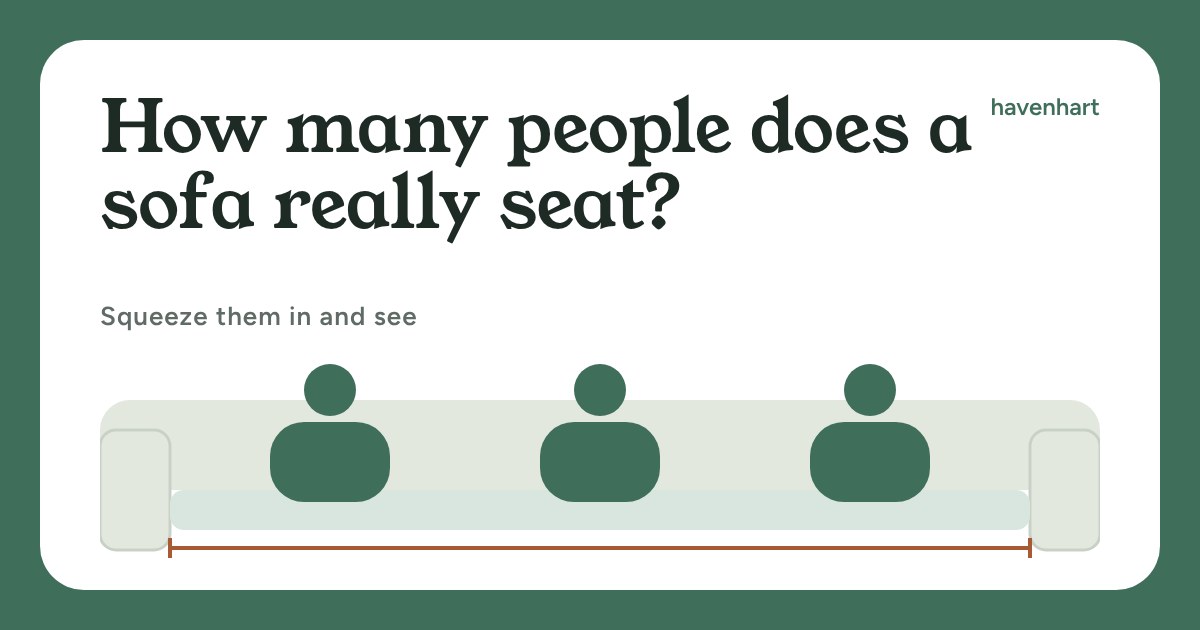
A sofa label says "3-seater", and it sounds like a promise. It is a guess. Nobody agrees on how wide a "seat" is, and the arms and frame take a slice of the length before anyone sits down. The honest question is how much room each person gets between the arms.
Squeeze them in
Set the sofa's overall width and the thickness of its arms, then add people. When two sets of shoulders overlap, they turn terracotta.
Why the label misleads
Two things shrink the seat. First, the arms and frame: on a chunky sofa they take a big slice of the overall length, so a 220 cm sofa can have much less usable seat than the number suggests. Second, the label counts cushions or "average" people, and nobody defines either.
As a rough guide, shops list 2-seaters at around 140–180 cm wide overall and 3-seaters at around 200–250 cm. The same label covers sofas with very different seats, so look for the seat width between the arms in the specification, and divide that.
The 60 cm rule, and where it comes from
A common rule of thumb is about 60 cm (24 inches) of seat width per adult. Body measurements show why it works. In US adult survey tables, hips measure roughly 31–40 cm across and shoulders roughly 41–57 cm, depending on build and sex. Add clothes, a cushion's squish and elbows that need somewhere to rest, and 60 cm gives everyone a little air.
It is a comfort rule, not a limit. Sofas often hold one more person than the rule says for a short time, and a household who like to be close may choose less. A household with a lot of sprawling may want more.
Use it before you buy, or before you rearrange
Count the people who sit there at the same time on a normal evening, not the people you might host twice a year. Then multiply by about 60 cm and compare with the seat width between the arms. If the sofa is short, an armchair or a pouffe next to it adds a place to sit for much less floor than a longer sofa.
If you already own the sofa, you don't have to replace anything. Slim, rolled arms free more seat than fat ones, a bench or ottoman at the end gives an extra place for guests, and moving a cushion pile off the seat gives back the room it was quietly taking.
What to measure
- Seat width between the arms on the sofa you like, with a tape measure along the front of the cushions. If the maker lists it, use that number.
- Overall width against the wall space, and the doorways and stairs on the way in (see our guide to getting a sofa through the door).
- How many people sit at once in a normal week, then add one for an occasional guest.
Cosy is not about the biggest sofa. A well-placed 2-seater with a good armchair often feels warmer than a 3-seater squeezed against one wall.